
Description
Threaded Unequal Cross: Industrial Four-Way Pipe Fitting for Different Pipe Sizes
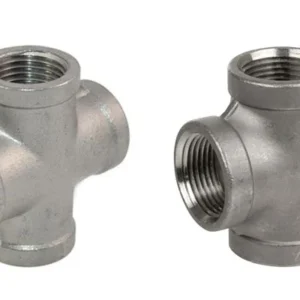
A Threaded Unequal Cross is a specialized pipe fitting designed to create a four-way connection where the connected openings are not all the same nominal size. It is useful in piping arrangements where multiple lines meet at one point but the piping dimensions need to transition between different sizes. The threaded connection provides a mechanical joining method for compatible threaded piping systems.
Unlike a threaded equal cross, which generally has openings of the same nominal size, an unequal cross incorporates different connection sizes according to its configuration. This makes it relevant for selected piping layouts where size transitions and multiple branch connections are required.
For industrial procurement, selecting the correct fitting requires consideration of pipe dimensions, thread compatibility, material, pressure, temperature, media, installation requirements, and applicable project specifications. Masiva Metals can be approached for industrial piping product requirements and international sourcing.
Threaded Unequal Cross
A Threaded Unequal Cross is a four-way pipe fitting with threaded connections in which one or more openings differ in nominal size. It provides a central connection point for multiple piping directions while accommodating different pipe dimensions.
This configuration can be useful when a piping network requires four connections but does not have identical pipe sizes at every opening. The exact arrangement of the larger and smaller ports depends on the product design and application.
When specifying a Threaded Unequal Cross, buyers should confirm:
- Main connection size.
- Branch connection sizes.
- Thread type.
- Material.
- Pressure requirements.
- Temperature range.
- Fluid or media compatibility.
- Applicable specifications.
- Product dimensions.
- Required inspection documentation.
A technical drawing should be requested when the fitting configuration is specialized or when the product is being used as a replacement for an existing component.
Threaded Unequal Crosses
Threaded Unequal Crosses are designed for four-way piping connections involving different nominal pipe sizes. They can provide an alternative to assembling multiple fittings where a suitable specialized cross configuration is available.
Potential advantages of this configuration include:
- Four-way connection capability.
- Accommodation of different pipe sizes.
- Threaded mechanical connections.
- Compact piping arrangements.
- Simplified component layout in suitable applications.
- Availability for industrial piping requirements.
The exact benefits depend on the fitting’s geometry and the piping system in which it is installed. Engineers should verify the flow arrangement and connection suitability before specifying the fitting.
Unequal Threaded Cross
An Unequal Threaded Cross provides multiple threaded connections with different nominal sizes. It is sometimes considered when a conventional equal cross cannot accommodate the required piping dimensions.
For example, a piping system may have a larger primary connection and smaller auxiliary lines that need to meet at a common point. An unequal cross can provide a purpose-designed connection arrangement when the required configuration is available.
Before selecting an unequal threaded cross, verify:
- Size arrangement.
- Port orientation.
- Thread specifications.
- Material grade or specification.
- Operating pressure.
- Operating temperature.
- Media compatibility.
- Space limitations.
- Applicable engineering standards.
The product should be selected according to the actual system design rather than only the nominal product description.
Reducing Threaded Cross
A Reducing Threaded Cross is another term that can be used to describe a threaded cross configuration incorporating different connection sizes. The reducing feature allows the fitting to connect piping of different nominal dimensions.
This can be useful in selected piping systems where four connections are required but the connected lines have different sizes.
A reducing threaded cross should be evaluated carefully for:
- Size reduction arrangement.
- Thread compatibility.
- Flow requirements.
- Pressure and temperature.
- Material compatibility.
- Installation conditions.
- Applicable project requirements.
For a specialized fitting, customers should provide a dimensional drawing or complete size configuration to the supplier to avoid receiving an incorrect arrangement.
Threaded Cross Fitting
A Threaded Cross Fitting connects four sections of piping at a common intersection. When the fitting is unequal, its openings are configured for different nominal sizes.
Threaded cross fittings can be considered for various industrial piping arrangements where threaded connections are technically appropriate. They may be useful in equipment connections, auxiliary piping, utility systems, maintenance applications, and selected process piping arrangements.
When ordering a threaded cross fitting, customers should provide:
- Product type.
- Port sizes.
- Thread type.
- Material.
- Quantity.
- Application.
- Required documentation.
- Delivery location.
- Applicable standards or project specifications.
Complete technical information is particularly important for unequal fittings because the connection-size arrangement can vary.
Unequal Cross Fitting
An Unequal Cross Fitting provides four connection points while accommodating different pipe sizes. It can be used when a piping design requires multiple lines to meet at one point without maintaining the same nominal diameter at every connection.
The unequal configuration can help address specific routing and connection requirements. However, engineers should consider whether a four-way connection is appropriate for the intended flow conditions.
Important considerations include:
- Number of different pipe sizes.
- Position of each connection.
- Branch dimensions.
- Thread specifications.
- Material.
- Pressure rating or service limitations.
- Temperature.
- Fluid characteristics.
- Applicable standards.
The exact configuration should be confirmed from the manufacturer’s technical drawing before approval.
Threaded Pipe Cross
A Threaded Pipe Cross is a four-way fitting designed to connect compatible threaded pipes. An unequal version accommodates different pipe sizes at its openings.
It can be considered for:
- Utility piping.
- Industrial service lines.
- Equipment connections.
- General mechanical piping.
- Plant maintenance.
- Selected process systems.
- Auxiliary piping arrangements.
The fitting should only be used where threaded connections are permitted by the applicable engineering design. High-pressure, high-temperature, high-vibration, or safety-critical applications may require a different connection technology depending on the system requirements.
Industrial Threaded Cross
An Industrial Threaded Cross is a four-way threaded fitting intended for suitable industrial piping applications. When configured as an unequal cross, it can accommodate different pipe sizes within the same connection assembly.
Potential application sectors include:
- Chemical processing.
- Petrochemical facilities.
- Manufacturing plants.
- Industrial utilities.
- Process equipment.
- Mechanical systems.
- Maintenance and replacement projects.
- General plant piping.
The fitting’s actual suitability depends on the material, dimensions, connection configuration, service conditions, and applicable project requirements.
For demanding applications, technical approval should be obtained from the responsible engineering team before installation.
Threaded Cross Manufacturer
Choosing a reliable Threaded Cross Manufacturer is important when sourcing specialized four-way pipe fittings. An experienced manufacturer or supplier should be able to understand the required port arrangement, dimensions, thread configuration, and material specification.
When evaluating a manufacturer, buyers can consider:
- Product range.
- Manufacturing capabilities.
- Dimensional consistency.
- Material identification and documentation.
- Quality inspection procedures.
- Technical support.
- Packaging.
- Export capabilities.
- Ability to address project-specific requirements.
Masiva Metals can be approached with complete requirements for a Threaded Unequal Cross, including dimensions, materials, thread details, quantity, and destination.
Threaded Cross Supplier
A dependable Threaded Cross Supplier can help customers source fittings according to specific industrial requirements. This becomes especially important for unequal fittings because multiple port sizes must be correctly identified.
Customers should ideally provide:
- Run size.
- Branch sizes.
- Thread type.
- Material.
- Quantity.
- Application.
- Operating conditions where relevant.
- Required inspection documentation.
- Delivery destination.
For replacement projects, supplying a drawing or photographs along with dimensions can help clarify the required configuration.
Threaded Unequal Cross Manufacturer in Italy & Belgium
Customers searching for a Threaded Unequal Cross Manufacturer in Italy & Belgium may require specialized four-way fittings for industrial piping, plant maintenance, equipment connections, or engineering projects.
For procurement in these markets, buyers should specify all connection sizes individually. Because an unequal cross has different port dimensions, simply stating one nominal pipe size may not be sufficient.
Thread configuration, material, documentation, and applicable project requirements should also be confirmed before ordering.
Threaded Unequal Cross Supplier in UAE
A Threaded Unequal Cross Supplier in UAE can support customers seeking four-way threaded fittings for appropriate industrial applications.
UAE projects can involve process systems, utility piping, equipment connections, manufacturing facilities, and maintenance requirements. Customers should provide the complete port-size arrangement and thread specifications when requesting a quotation.
For critical applications, pressure, temperature, and media compatibility should also be reviewed.
Threaded Unequal Cross Manufacturer in Spain
A Threaded Unequal Cross Manufacturer in Spain can serve industrial customers requiring four-way threaded fittings with different connection sizes.
Before purchasing, buyers should verify the required dimensions, material, thread type, port arrangement, and applicable specifications. Technical drawings are particularly useful when the fitting has a non-standard configuration.
International customers should also confirm documentation, packaging, and delivery requirements.
Threaded Unequal Cross Supplier in Germany & South Korea
A Threaded Unequal Cross Supplier in Germany & South Korea can support engineering and industrial customers looking for specialized threaded piping components.
The supplier should receive complete technical details, especially the size of each opening. Customers should also confirm whether the fitting is intended for a new installation or as a replacement component.
For replacement applications, matching the existing thread configuration and dimensions is essential.
Threaded Unequal Cross Manufacturer in Italy
A Threaded Unequal Cross Manufacturer in Italy can be considered for projects requiring four-way threaded connections with different pipe sizes.
Buyers should provide the exact size arrangement, thread specification, material requirements, quantity, and project documentation needs. For engineered systems, the final product should be reviewed against the approved piping design.
Threaded Unequal Cross Supplier in Belgium
A Threaded Unequal Cross Supplier in Belgium can support customers requiring specialized industrial pipe fittings.
Because different thread systems may be encountered in international piping applications, customers should clearly specify the required thread standard. Pipe nominal size alone may not identify the correct threaded connection.
Material and operating requirements should also be communicated during procurement.
Threaded Unequal Cross Manufacturer in Germany
A Threaded Unequal Cross Manufacturer in Germany can support customers seeking specialized four-way industrial pipe fittings with unequal connection sizes.
For accurate procurement, customers should provide product dimensions, port arrangement, material specification, thread type, quantity, and applicable project standards.
Where required, buyers should request technical drawings and inspection documentation before approving the fitting.
Threaded Unequal Cross Supplier in Vietnam & Philippines
A Threaded Unequal Cross Supplier in Vietnam & Philippines can support customers involved in industrial piping, equipment installation, manufacturing, and maintenance projects.
International buyers should consider both technical and logistical requirements. Product specifications, documentation, packaging, shipping arrangements, and delivery terms should be confirmed before finalizing the order.
Threaded Unequal Cross Manufacturer in Saudi Arabia & UAE
A Threaded Unequal Cross Manufacturer in Saudi Arabia & UAE can be considered by industrial customers requiring specialized four-way threaded fittings for suitable applications.
Customers should provide all connection sizes, thread details, material requirements, quantity, and service conditions. For demanding systems, the responsible engineering team should verify that the fitting is suitable before installation.
Applications of Threaded Unequal Cross
A Threaded Unequal Cross may be considered for piping arrangements where four connections are required but the connected pipe sizes are different.
Potential applications include:
- Industrial utility piping.
- Process piping.
- Equipment connections.
- Manufacturing facilities.
- Mechanical piping systems.
- Plant maintenance.
- Auxiliary piping.
- Service lines.
- Selected fluid distribution systems.
- Replacement piping applications.
The actual application should always be evaluated according to the fitting’s design and the system’s engineering requirements.
Advantages of Threaded Unequal Cross
A correctly selected Threaded Unequal Cross can provide several practical benefits.
These may include:
- Four-way piping connection.
- Accommodation of different pipe sizes.
- Threaded mechanical assembly.
- Compact connection arrangement.
- Potentially simplified piping layouts.
- Useful solution for selected replacement applications.
- No welding operation at the threaded connection itself.
However, a four-way fitting can influence flow distribution and pressure behavior. The responsible engineer should determine whether the configuration is appropriate for the intended service.
Threaded Unequal Cross vs Threaded Equal Cross
The main difference is the size arrangement of the openings.
A Threaded Equal Cross generally has four openings of the same nominal size.
A Threaded Unequal Cross has one or more openings with different nominal sizes.
An equal cross may be appropriate when all connected piping sections have the same nominal diameter. An unequal cross can be considered when the piping network requires different connection sizes.
The correct choice depends on the actual piping design.
Threaded Unequal Cross vs Threaded Tee
A threaded tee generally has three openings, while a threaded cross has four.
A tee can provide:
- One main run.
- One branch.
- Three total openings.
An unequal cross provides:
- Four connection points.
- Multiple piping directions.
- Different connection sizes in its unequal configuration.
If only one branch is required, a tee may be more appropriate. If four connections must meet at a common point, a cross may be considered.
How to Select the Right Threaded Unequal Cross
Correct selection should be based on the complete technical requirement.
1. Identify Every Port Size
Unlike an equal cross, an unequal cross can have multiple sizes. Specify each opening individually.
2. Confirm Thread Type
Check that every threaded connection is compatible with the mating piping component.
3. Select Material
The material should be appropriate for the conveyed media and environmental conditions.
4. Evaluate Pressure
Confirm the fitting’s suitability for the required operating conditions.
5. Evaluate Temperature
The expected operating temperature should be considered during material and fitting selection.
6. Check Media Compatibility
Corrosive or chemically active media may require specific material selection.
7. Review Flow Requirements
A four-way intersection can affect flow behavior. The fitting arrangement should be reviewed as part of the complete piping design.
8. Confirm Dimensions
Review all connection dimensions and overall fitting geometry.
9. Verify Applicable Standards
Confirm the specifications required by the project or customer.
10. Confirm Documentation
Determine whether material, dimensional, inspection, or other documentation is required.
Thread Compatibility and Installation
Thread compatibility is essential for a reliable connection. The fitting and mating pipe or component should use compatible thread specifications and dimensions.
During installation:
- Inspect all threads.
- Clean the connection surfaces.
- Check for damaged or deformed threads.
- Confirm correct alignment.
- Apply an appropriate sealing method.
- Tighten according to the applicable procedure.
- Avoid excessive force.
- Inspect the completed assembly.
- Perform leakage testing when required.
For critical or hazardous services, installation should be performed by qualified personnel according to approved procedures.
Quality Inspection of Threaded Unequal Cross
Quality evaluation may include visual, dimensional, material, and thread-related inspection depending on the application.
Customers may require:
- Dimensional inspection.
- Material documentation.
- Product drawings.
- Thread inspection.
- Visual inspection.
- Test documentation where applicable.
- Traceability documentation where specified.
The exact inspection package should be agreed with the supplier before production or dispatch.
Ordering Threaded Unequal Cross from Masiva Metals
Customers can simplify the procurement process by providing complete product details when requesting a quotation from Masiva Metals.
Recommended information includes:
- Product name: Threaded Unequal Cross.
- Size of each connection.
- Thread specification.
- Material.
- Quantity.
- Application.
- Operating conditions where relevant.
- Applicable standard or project specification.
- Required documentation.
- Delivery destination.
- Required delivery schedule.
For non-standard configurations, a technical drawing is strongly recommended.
Why Choose Masiva Metals?
Masiva Metals supports industrial customers with metal and piping product requirements for different engineering and procurement applications.
For Threaded Unequal Cross requirements, customers can submit their required dimensions, port arrangement, thread type, material, quantity, documentation requirements, and delivery destination for evaluation.
For international projects, clearly defining the fitting configuration is particularly important because terminology and thread standards can vary between markets.
FAQs About Threaded Unequal Cross
What is a Threaded Unequal Cross?
A Threaded Unequal Cross is a four-way pipe fitting with threaded connections where one or more openings have different nominal sizes.
What is a reducing threaded cross?
A reducing threaded cross is a four-way threaded fitting designed with different connection sizes, allowing piping of different nominal dimensions to connect at one intersection.
What is the difference between an equal and unequal cross?
An equal cross generally has four openings of the same nominal size, while an unequal cross has different opening sizes according to its configuration.
What is the difference between a cross and a tee?
A tee has three openings, while a cross has four connection points.
Where can Threaded Unequal Cross fittings be used?
They may be considered for suitable industrial, utility, process, equipment, mechanical, maintenance, and auxiliary piping applications.
Are threaded unequal crosses suitable for every industrial application?
No. Suitability depends on material, dimensions, thread configuration, pressure, temperature, media, vibration, applicable standards, and engineering requirements.
How should I specify a Threaded Unequal Cross?
Provide the size of every connection, thread type, material, quantity, application, applicable specifications, and documentation requirements.
Can Masiva Metals supply Threaded Unequal Cross internationally?
Masiva Metals can be approached for industrial piping requirements for international projects. Customers should provide complete technical specifications and delivery requirements for evaluation.
Conclusion
A Threaded Unequal Cross is a specialized four-way pipe fitting designed to connect multiple piping sections where the connection sizes are not identical. Its threaded configuration can provide a practical mechanical connection for compatible piping systems, while its unequal port arrangement allows different pipe sizes to meet at a common intersection.
The most important considerations when selecting a Threaded Unequal Cross are connection sizes, thread compatibility, material, pressure, temperature, media, dimensions, flow requirements, applicable standards, and installation conditions.
For industrial and international sourcing, Masiva Metals can be approached with complete product requirements. Share the required connection sizes, thread specification, material, quantity, documentation requirements, and delivery destination to identify the appropriate configuration for your project.